
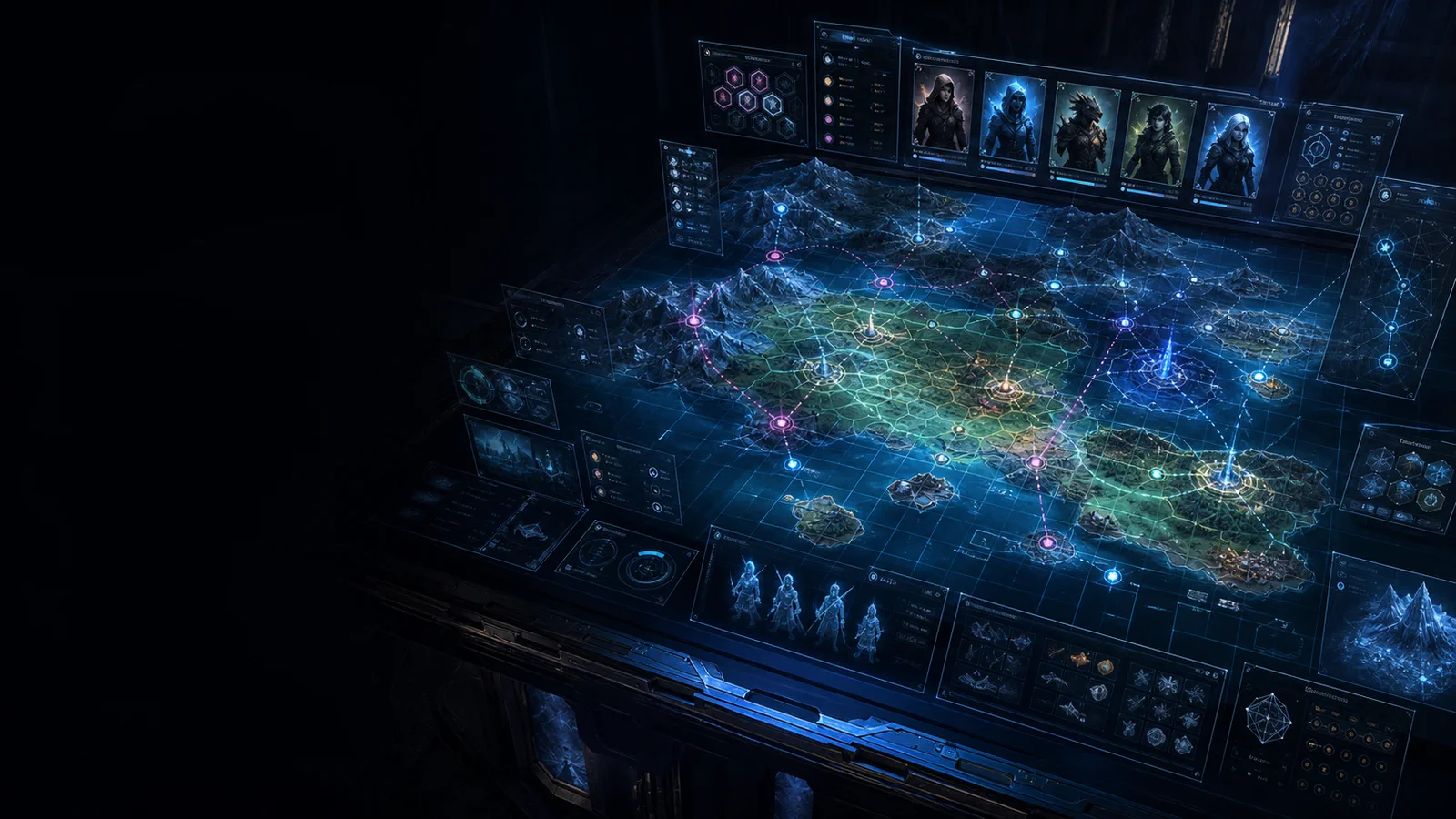
One campaign, one connected memory.
Tempest Tabletop Engine brings characters, maps, encounters, dice, campaign records, rules adapters, lore, and constructed languages into one local-first workspace.
The campaign remains the persistent gamespace while focused overlays and workspaces handle characters, encounters, dice, maps, translation, languages, and the event journal without breaking spatial context.
Campaign truth is signed and recoverable.
A versioned SQLite workspace stores multiple isolated campaigns. Mutations become ordered, hash-linked events, protected by a device-local identity and filtered into GM, player, and shared-display projections before they leave the authority.
- Authoritative public, player-private, and GM-private dice results with accessible 3D, 2D, text, and reduced-motion presentations.
- Event-sourced encounters with deterministic initiative, rounds, conditions, and role-filtered participants.
- Verified portable backups, transactional restore, device pairing, membership, ownership, and revocation controls.
Maps and languages belong to the same world.
Map Studio supports square, hex, and gridless scenes, tokens, measurement, projected fog, rooms, walls, doors, terrain, lights, reusable scenes, deterministic dungeon generation, and a campaign atlas linked to locations and encounters.
The shared Tempest language core keeps names, dialogue, inscriptions, grammar evidence, and translation decisions consistent. Campaign terminology can propose new language work, but it never overrides reviewed canon by accident.